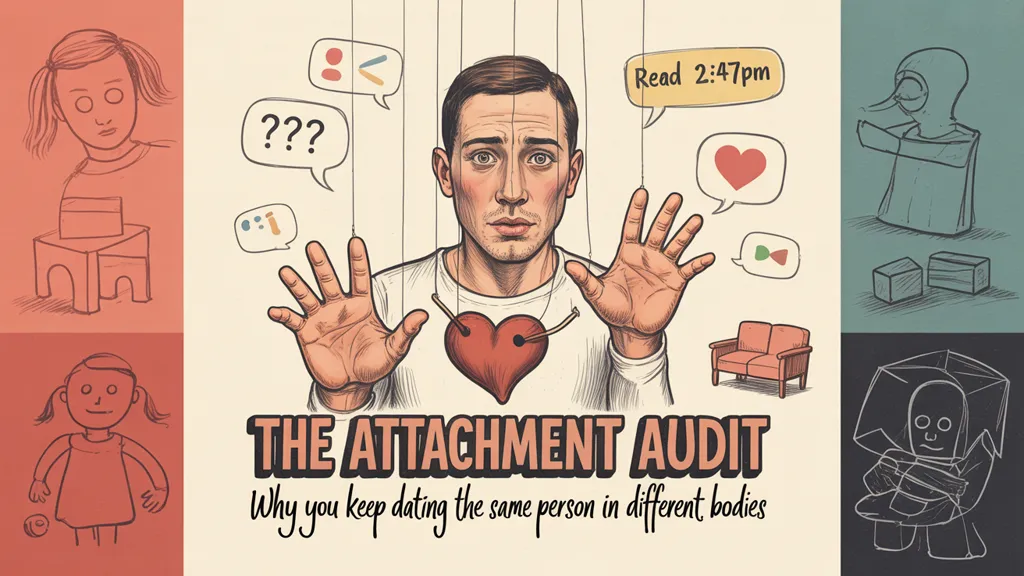
The Attachment Audit: Or, Why You Keep Dating the Same Person in Different Bodies
A brutally honest (and slightly chaotic) guide to discovering your relationship blueprint
You know that moment when you finish a relationship and think, "Well, that was a complete disaster. Never doing THAT again," only to find yourself six months later in the exact same situation with a completely different person who somehow has the same emotional unavailability, just in a new outfit?
Yeah. Everyone's been there.
And for the longest time, most people think they just have terrible taste in partners. Like maybe they're walking around with a neon sign on their forehead that says "EMOTIONALLY UNAVAILABLE PEOPLE, APPLY HERE" or something.
But then they learn about attachment theory, and suddenly their entire romantic history makes sense. Like, uncomfortably accurate sense. The kind of sense that makes someone want to call their therapist immediately and also maybe apologize to a few exes.
Welcome to The Attachment Audit—where we're about to figure out why people do the weird, self-sabotaging things they do in relationships. And trust me, it's not because anyone's broken or cursed or because Mercury is always in retrograde when they're trying to date.
It's because everyone has an attachment style. And that attachment style has been running their love life like a puppet master since they were, like, three years old.
Fun, right?

What the Heck Is Attachment Theory? (The Cliff Notes Version)
So back in the 1950s, this British psychologist named John Bowlby was studying kids who'd been separated from their parents during World War II. And he noticed something wild: the way kids responded to being separated from their caregivers fell into predictable patterns.
Some kids were like, "Mom's back! Great! Anyway, back to my blocks."
Others completely melted down and couldn't be comforted even when their mom returned.
And some kids barely even noticed their mom had left in the first place.
Then this researcher named Mary Ainsworth came along and did what's called the "Strange Situation" experiment, which is basically just watching what happens when you leave a baby alone with a stranger for a bit and then bring the parent back. (Don't worry, the babies were fine. Probably. This was the '70s.)
And here's the kicker: those childhood patterns don't just disappear when someone grows up. They become the lens through which they experience adult romantic relationships.
So that thing someone does where they need constant reassurance? That's not a personality flaw. That's their attachment style.
That thing where they ghost people the second things start to get close? Also their attachment style.
That thing where they simultaneously want someone to commit and also want to run away screaming? You guessed it. Attachment style.
The Four Attachment Styles (AKA: Which Disaster Are You?)
There are four main attachment styles, and we're gonna break them down in the most relatable, judgment-free way possible. Because here's the thing: none of these are anyone's fault. Nobody woke up one day and decided to be a hot mess in relationships. Their nervous system learned how to survive their childhood, and now it's just... doing its job.
Even if that job is making their dating life a nightmare.
1. Secure Attachment (The Unicorn)
If someone's securely attached, congratulations! They won the attachment lottery! They probably don't even realize how good they have it!
Secure attachment is like... being a golden retriever in human form. They trust people. They communicate their needs clearly. When someone says "I need space," they're like, "Cool, see you later!" instead of spiraling into an existential crisis about whether they still love them.
When they have a fight with their partner, they don't immediately think the relationship is over. They think, "Okay, we have a problem. Let's fix it like adults."
They can handle intimacy without feeling suffocated. They can handle space without panicking. They're basically the relationship equivalent of someone who can actually maintain a work-life balance.
The Text Message Test:
Their partner doesn't respond for three hours. Their reaction? "Huh, they must be busy." And then they... go about their day. Like a psychopath. (Kidding. They're the only sane ones here.)
If this is you, you can honestly skip the rest of this post. Go enjoy your healthy relationships and your good night's sleep and your ability to not overthink everything. The rest of us will be over here doing therapy.

2. Anxious Attachment (The Stage 5 Clinger)
[Deep breath]
Hi. Hello. Welcome to our people.
If someone has anxious attachment, their biggest fear is abandonment. Not like "oh I hope they don't leave" fear, but like deep, primal, gut-wrenching terror that everyone they love is going to realize they're not enough and bail.
So they compensate by... doing all the things that ironically push people away.
Someone might be anxiously attached if:
- They've checked their phone 47 times in the last hour waiting for a text back, and yes, they counted
- Their mood is 100% dependent on how their relationship is going at any given moment
- They've started planning the wedding after the second date (in their head, obviously, they're not a TOTAL psycho)
- The phrase "I need space" sends them into a full-blown panic spiral
- They've sent the "Hey, just checking in!" text three times in one day and it's only noon
- They Google "signs your partner is losing interest" approximately once a week
- They have a very hard time being alone because it feels like death
- They need reassurance constantly, but when they get it, the relief lasts approximately 20 minutes before the doubt creeps back in
Here's what happened: When they were a kid, their caregivers were inconsistent. Sometimes they were there, sometimes they weren't. Sometimes they were warm and loving, sometimes they were cold or distracted. They never knew which version they were going to get.
So their nervous system learned to amplify their distress signals. "If I cry loud enough, MAYBE they'll come. If I'm charming enough, MAYBE they'll stay."
As an adult, this looks like what people annoyingly call "clinginess" or "neediness." But it's not that they're fundamentally needy. It's that their nervous system learned that love is unpredictable, so they're always trying to secure it by... well, by being A LOT.
Real talk story time:
Have you ever dated someone who took four hours to respond to a text? FOUR HOURS. And in those four hours, you had:
- Decided that they were definitely losing interest
- Analyzed every interaction you've ever had in the past week
- Convinced yourself you'd said something wrong
- Drafted (but thankfully didn't send) a "we need to talk" text
- Told your best friend the relationship was probably over
- Started mentally preparing for being single forever
...and then they texted? "Sorry, my phone died. Wanna go out later?"
This, my friends, is anxious attachment in its natural habitat.
The cruel irony is that the behaviors used to keep people close (constant checking in, seeking reassurance, emotional intensity, needing to be in contact 24/7) are the exact behaviors that push people away. Especially if someone's dating an avoidant person, which—plot twist—they probably are.
3. Avoidant Attachment (The Commitment-Phobe)
If someone's avoidant, their biggest fear isn't abandonment. It's engulfment. Being trapped. Losing themselves in a relationship. Becoming "we" when they very much prefer to be "I."
They value independence above almost everything else. They might even pride themselves on "not needing anyone." Which is, let's be honest, a trauma response disguised as strength.
Someone might be avoidantly attached if:
- When someone says "I love you" their first instinct is to run
- "Let's have a deep conversation about our feelings" sounds like actual torture
- They've ended relationships right when they were getting good because suddenly it felt "too serious"
- They focus intensely on their partner's flaws as a way to keep emotional distance
- Their response to conflict is to shut down, withdraw, or disappear
- They need A LOT of alone time, and when their partner wants more connection, they feel suffocated
- They intellectualize emotions instead of feeling them: "I don't understand why people get so upset about these things. It's not logical."
- They've described themselves as "not that emotional" or "just realistic about relationships"
- Their exes have called them "emotionally unavailable" and they were like "...yeah, so?"
Here's what happened: Their caregivers were probably physically present but emotionally checked out. When they expressed needs or emotions as a kid, those feelings were dismissed, minimized, or ignored. So they learned that feelings are inconvenient and needs won't be met anyway.
Their survival strategy? Stop having needs. Stop feeling feelings. Become entirely self-sufficient because depending on others is dangerous.
As an adult, they can DO intimacy on a surface level. They can date. They can even be in long-term relationships. But when things start to get really real—when someone wants to move in together, or get engaged, or just like... have a vulnerable conversation—their nervous system screams "DANGER! ABORT MISSION!" and they start creating distance.
How they create distance without even realizing it:
- Suddenly they're "really busy with work"
- They start picking fights about small, stupid things
- They focus on all the ways their partner isn't perfect
- They fantasize about an ex or about being single
- They withdraw emotionally while staying physically present (the old "I'm here but I'm not HERE" move)
There's a tragedy to this: They DO want connection. They're human. Of course they do. But their nervous system has been trained to perceive closeness as a threat. So they end up in this painful place where they're lonely but also can't let anyone in.

4. Fearful-Avoidant Attachment (The "Come Here, Go Away" Special)
Oh boy. Okay. If someone's fearful-avoidant (also called disorganized attachment), they basically got the worst of both worlds. They have BOTH anxious AND avoidant patterns, which means they simultaneously desperately want closeness AND are terrified of it.
Fun! So fun! (It's not fun. I'm so sorry.)
Someone might be fearful-avoidant if:
- They pursue people intensely, and the second those people reciprocate, they panic and push them away
- They feel like they're in a constant internal war with themselves about what they want
- Their relationships are intense, chaotic, and exhausting
- They swing between "I LOVE YOU SO MUCH" and "I need to get out of here immediately"
- They have a history of dramatic breakups and makeups
- They can't predict their own behavior in relationships
- They both crave and fear emotional intimacy
- They feel like they're "too much" and "not enough" at the same time
Here's what happened: Fearful-avoidant attachment usually develops when the person who was supposed to be their source of safety was ALSO their source of fear. Maybe there was abuse, trauma, or very chaotic, unpredictable caregiving.
Their nervous system never learned a coherent strategy because the signals were completely mixed. "Come here!" and "Go away!" at the same time. So now, as an adult, they're operating with two contradictory instruction manuals running simultaneously.
What this looks like in practice:
- They pull someone close emotionally and then ghost them
- They're convinced they've found "the one" and then suddenly that person is "all wrong"
- They create chaos to test if people will stay
- They self-sabotage right when things are going well
- They have a LOT of shame about their relationship patterns
If this is you: You are not broken. You are not crazy. You developed this pattern as a survival response to an impossible situation. And yes, it's going to take more work to heal, and yes, a trauma-informed therapist is a really good idea. But it IS possible to move toward secure attachment.
The Anxious-Avoidant Trap (AKA: Hell Is Other People, Specifically These Two)
Now here's where it gets REALLY fun (by "fun" I mean "makes you want to scream into the void").
Anxious and avoidant people are magnetically attracted to each other. Like the universe is playing the cruelest joke imaginable.
Here's how it works:
The anxious person craves closeness and pursues it actively. "Let's talk! Let's spend time together! Let's merge our souls!"
The avoidant person values space and starts to pull away. "I need some alone time. This is feeling like a lot."
The pulling away triggers the anxious person's abandonment panic, so they pursue HARDER. More texts. More "are we okay?" conversations. More emotional intensity.
The harder the anxious person pursues, the more the avoidant person withdraws to protect their sense of autonomy. "Why are they so clingy? I can't breathe!"
Which makes the anxious person pursue even MORE intensely because now they're convinced the person is leaving.
Which makes the avoidant person withdraw even MORE because this is exactly why they avoid relationships in the first place.
And round and round they go until someone finally ends it or both people collapse from exhaustion.
Neither person is the villain here. This is so important to understand. Both are responding from their wounds. Both are trying to feel safe using the only strategies they know.
The anxious person thinks: "If I just try hard enough, if I'm just perfect enough, they'll finally stay."
The avoidant person thinks: "If I just get enough space, if they would just stop being so intense, I could breathe."
But the strategies are completely incompatible. It's like two people speaking different languages and getting increasingly frustrated that the other person doesn't understand.
Plot twist: Often, anxious people are attracted to avoidant people BECAUSE the unavailability feels familiar. Their nervous system recognizes the pattern from childhood—"Love is unpredictable and I have to work for it"—and mistakes that anxiety for chemistry.
And avoidant people are attracted to anxious people because the pursuit feels validating at first... until it doesn't.
It's a disaster. A predictable, pattern-based disaster.

The Self-Assessment Quiz (Time to Get Real With Yourself)
Okay, you've read this far, which means you're either:
- Highly invested in understanding yourself
- Procrastinating on something important
- Lowkey worried you're a walking red flag
Whatever your reason, let's do this. Here are five questions, and answer HONESTLY. Not how you wish you'd respond. Not how you think you SHOULD respond. How you ACTUALLY respond.
Ready?
Question 1: Your partner texts you saying they need some alone time tonight. What's your immediate, gut reaction?
A) "Cool, I actually have stuff I want to do too. Talk tomorrow!"
B) [Immediate panic] "Did I do something wrong? Are they mad at me? Are they pulling away? Should I ask if we're okay?"
C) [Relief] "Thank god. I was feeling a bit suffocated anyway."
D) [Internal chaos] Part of me is relieved, part of me is panicking, I have no idea how to feel about this.
Question 2: Think about your last big fight or breakup. What did you do?
A) I tried to communicate and work through it, even though it was hard.
B) I immediately tried to fix it, apologized even if it wasn't my fault, and basically did anything to make them stay.
C) I shut down, withdrew, and maybe even ended things to avoid the discomfort of conflict.
D) I oscillated wildly between wanting to fix it and wanting to run away. Maybe I did both.
Question 3: Someone you're dating wants to have a "deep conversation about feelings." Your honest reaction?
A) "Sure, let's talk. I want to understand where you're coming from."
B) "Yes! I LOVE these conversations! Let me tell you all my feelings!"
C) [Internal screaming] "Can we not? This feels like a trap. Why do we have to analyze everything?"
D) I want to have it AND I want to avoid it. I'll probably start the conversation and then shut down halfway through.
Question 4: You're newly dating someone. What's your vibe?
A) I'm taking my time, seeing if we're compatible, enjoying getting to know them.
B) I'm ALL IN. Already thinking about the future, texting constantly, organizing my life around them.
C) I'm keeping my guard up, looking for red flags, maintaining lots of independence.
D) I'm swinging between "this is amazing I'm so into you" and "wait maybe this is a mistake."
Question 5: Describe your relationship history in one sentence.
A) Generally healthy with normal ups and downs, some worked out and some didn't.
B) Intense and usually one-sided. I tend to love harder than I'm loved back.
C) I often felt trapped or suffocated, ended things before they got too serious.
D) Chaotic, dramatic, and exhausting. Lots of breakups and makeups and confusion.
SCORING:
Mostly A's: You're secure! Congrats! You're the person the rest of us are trying to become. Share your secrets.
Mostly B's: You're anxious. Welcome to the club. We meet every hour on the hour to overthink text messages.
Mostly C's: You're avoidant. You probably almost didn't finish reading this because feelings make you uncomfortable. But you did! Growth!
Mostly D's: You're fearful-avoidant. I'm sorry. It's rough out here. Please get a good therapist if you don't have one already.
Mixed results: Welcome to being human! Most people aren't 100% one style. You might lean anxious in romantic relationships but secure with friends. You might be secure until you date someone who activates your anxious side. Context matters.
But Can I Change? Or Am I Doomed Forever?
Great question! The answer is: YES, PEOPLE CAN ABSOLUTELY CHANGE.
It's called "earned secure attachment," and it's backed by actual science, not just positive thinking and manifestation journals.
Your attachment style is basically your nervous system's default setting. It's the program that's been running in the background since childhood. But here's the beautiful thing about neuroscience: your brain is plastic. (Not literally plastic. That would be weird. It means it can change and rewire itself.)
Someone can develop secure attachment through:
1. Awareness
You're literally doing this right now by reading this. You can't change what you can't see.
2. Therapy
Especially attachment-focused or trauma-informed therapy. A good therapist can provide what's called a "corrective emotional experience"—basically, they show your nervous system that people can be consistently safe and available.
3. Secure Relationships
Being in relationships (romantic or otherwise) with securely attached people who don't abandon you when you're anxious or smother you when you're avoidant. Over time, your nervous system updates its expectations.
4. Intentional Practice
Doing the opposite of what your attachment style tells you to do:
- Anxious folks: Practice self-soothing instead of seeking immediate reassurance
- Avoidant folks: Practice vulnerability and staying present in discomfort
- Fearful-avoidant folks: Practice noticing your push-pull without acting on it immediately
5. Self-Compassion
Stop beating yourself up for your patterns. They made sense given your history. Honor that while also committing to growth.
Timeline reality check: This isn't a 30-day challenge. We're talking months to years of consistent work. But every person I know who's done this work says it's worth it. The alternative is continuing to repeat the same painful patterns for the rest of your life, so...
What To Actually DO With This Information
Okay, so you've identified your attachment style. You've had some uncomfortable realizations about your relationship patterns. Maybe you've texted your therapist. Maybe you've called your best friend crying. Maybe you're just sitting there like "...well, shit."
Now what?
If You're Anxious:
Your homework: Build a self-soothing toolkit. The next time you feel that spike of anxiety—the urge to text again, to ask if everything's okay, to create drama just to get engagement—STOP.
Take a breath. Say out loud: "This is my anxious attachment being activated."
Then do something to discharge that anxious energy WITHOUT involving your partner:
- Go for a walk or run
- Do ten push-ups
- Dance to a song you love
- Journal
- Call a friend (NOT your partner)
- Do the physiological sigh (two inhales through the nose, long exhale through the mouth)
The goal isn't to never feel anxious. The goal is to develop the capacity to hold that anxiety without immediately outsourcing it to someone else.
Also: Start reality-testing your catastrophic thoughts. "They haven't texted back in two hours" does not actually mean "They're definitely leaving me." Write down the facts versus the story you're telling yourself.
If You're Avoidant:
Your homework: Practice vulnerability. Share ONE feeling with your partner this week that feels uncomfortable.
Not a thought. Not an opinion. A feeling.
- "I feel scared when we talk about moving in together."
- "I feel overwhelmed when you ask me to share my emotions."
- "I feel like I'm going to disappoint you."
Notice your urge to intellectualize, minimize, or make a joke. Don't do that. Just sit in the discomfort of being emotionally honest.
Also: Pay attention to when you're creating distance. Are you suddenly "too busy" with work? Are you picking fights about small things? Are you mentally listing all your partner's flaws?
These are signs your nervous system feels threatened by closeness. Notice the pattern. Choose to stay anyway.
If You're Fearful-Avoidant:
Your homework: Just... notice. Seriously. The first step is developing the ability to observe your push-pull pattern without judgment.
"Oh, there I go again. I pulled them close and now I'm pushing them away."
Don't try to fix it yet. Just see it. Awareness creates the space for choice.
Also: Please find a trauma-informed therapist if you don't have one. This attachment style usually has roots in early trauma, and that needs professional support to heal. You deserve that support.
If You're Secure:
Your homework: Maintain your secure base while having compassion for partners with insecure attachment. Don't take their anxiety or avoidance personally—it's about their nervous system, not about you.
Model secure behavior. Show them what it looks like to communicate clearly, handle conflict without drama, and be both independent and connected.
Sometimes, being in a relationship with a secure person is the most healing thing for someone with insecure attachment.

The Bottom Line (AKA: You're Not Broken, You're Just Human)
Here's what everyone needs to hear: Your attachment style is not a character flaw.
You didn't wake up one day and decide to be anxious or avoidant or a confusing mix of both. Your nervous system adapted to survive your childhood environment. It learned the best strategies it could with the information it had.
That three-year-old who learned that love is unpredictable? They were doing their best.
That five-year-old who learned that emotions are inconvenient and needs won't be met? They were protecting themselves.
Those patterns made sense then. They kept you safe.
But now? Now they might be keeping you stuck.
The good news is: you're not that three-year-old anymore. You have agency now. You have awareness now. You can choose to do the work to rewire your nervous system.
It won't be quick. It won't be easy. There will be setbacks. You'll probably slip back into old patterns when you're stressed or triggered. That's normal. That's part of the process.
But if you commit to the journey—if you commit to understanding yourself, doing the uncomfortable work, choosing growth over comfort—you can absolutely move toward secure attachment.
And that means you can have the kind of relationships you actually deserve. The kind where you feel safe, not scared. The kind where you can be yourself without fear of abandonment or engulfment. The kind where love isn't a constant battle against your own nervous system.
P.S. If you want to dive even deeper into this, listen to Season 2, Episode 1 of the Connection Quest podcast where they walk you through the entire attachment audit with even more stories, examples, and practical tools.
And then stick around for Episodes 2 and 3 where they bring in actual experts to help you heal anxious and avoidant attachment specifically.
Because we're in this together. The quest continues.
Resources:
🎧 Listen to the episode: Connection Quest Season 2, Episode 2
📚 Recommended books:
- Attached by Amir Levine and Rachel Heller (The attachment Bible)
- Hold Me Tight by Dr. Sue Johnson (For couples work)
- Wired for Love by Stan Tatkin (Neuroscience meets attachment)
📝 Read more on the blog: blog.connectionq.us
📱 Follow for more brutal honesty about relationships: @connectionq_on Instagram
Comments section: Tell them which attachment style you are and whether you've ever called your therapist after learning about attachment theory. We're all in this mess together. 💕